Online gambling in Turkey faces strict regulatory restrictions, yet many players seek alternative ways to enjoy casino entertainment. Crypto casinos such as lüks casino provide access to slots, live dealer games, and sports betting using Bitcoin, Ethereum, USDT, and other digital currencies, bypassing traditional banking restrictions. Platforms operating under Curaçao licenses typically offer 5,000+ games, welcome bonuses up to 150% on initial deposits, and transaction speeds measured in minutes rather than days. This guide covers everything Turkish residents need to know about cryptocurrency gambling in 2026.
What Are Crypto Casinos?
A crypto casino operates exclusively or primarily with cryptocurrency payments instead of fiat money. Players deposit Bitcoin, Ethereum, Litecoin, or stablecoins like USDT into their gaming accounts, wager on slots or table games, and withdraw winnings directly to their personal wallets. Blockchain technology enables transparent, fast transactions without intermediaries.
Most platforms combine traditional casino games from providers like Pragmatic Play, Evolution Gaming, and NetEnt with cryptocurrency payment rails. The best crypto casino platforms in 2026 typically feature provably fair algorithms, allowing players to verify game outcomes independently using cryptographic hashes.
Unlike conventional online casinos that process payments through banks and card networks, cryptocurrency gambling sites connect directly to blockchain networks. This architecture reduces processing delays and bypasses geographic payment restrictions common in regions with tightened gambling regulations.
Are Crypto Casinos Accessible in Turkey?
Turkish players can technically access offshore crypto casino websites despite domestic gambling prohibitions. Turkey’s legislation bans all forms of online gambling except state-run lottery and sports betting monopolies, but enforcement targets primarily payment processors and local advertisers rather than individual users.
International platforms licensed in Curaçao, Malta, or Costa Rica accept registrations from Turkish residents. These sites operate beyond Turkish jurisdiction, using cryptocurrency payments that circumvent banking blocks. Internet service providers occasionally restrict access to gambling domains, yet mirror sites and VPN services maintain connectivity.
No Turkish regulatory body issues gambling licenses or monitors offshore operators. Players assume full responsibility when choosing platforms. The best crypto casino options for Turkish users prioritize licenses from recognized jurisdictions and established complaint resolution records.
Legal Considerations for Crypto Gambling in Turkey
Turkish law classifies online gambling as illegal under Law No. 7258, which consolidates earlier regulations. Authorities can fine or prosecute operators marketing services within Turkey, but prosecution of individual players remains exceptionally rare. The legal framework targets commercial organizers, not casual participants.
Cryptocurrency status in Turkey presents additional complexity. Bitcoin and altcoins are legal to own and trade, but a 2021 regulation prohibits their use as payment instruments for goods and services. This creates ambiguity: while owning Bitcoin remains lawful, using it to fund a crypto casino account technically violates payment instrument restrictions.
Players accessing offshore sites operate in a gray zone. Turkish courts have not established clear precedent for prosecuting individuals who gamble on foreign platforms using cryptocurrency. Most enforcement actions focus on blocking domains and penalizing local payment facilitators.
How Cryptocurrency Payments Work at Online Casinos
Depositing at a crypto casino begins with creating a gaming account and navigating to the cashier section. The platform generates a unique wallet address for the chosen cryptocurrency.
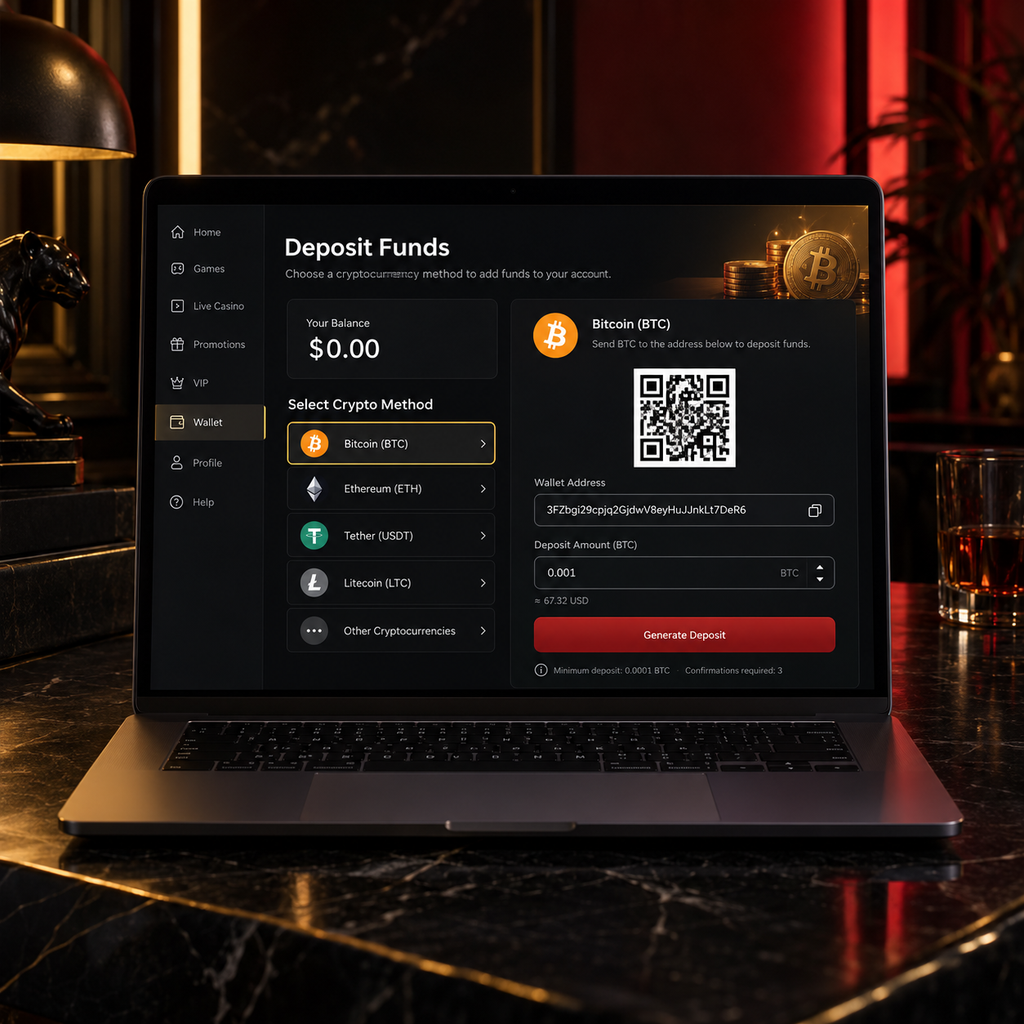
Players copy this address into their personal wallet application, specify the deposit amount, and broadcast the transaction to the blockchain network.
Confirmation times vary by coin: Bitcoin transactions typically require 10-60 minutes and 1-3 network confirmations, Ethereum completes in 2-5 minutes, while Litecoin and Dogecoin often clear within 5-15 minutes. Stablecoins like USDT on the Tron network can credit accounts in under two minutes. Once confirmed, funds appear in the casino balance, ready for wagering.
Withdrawals follow the reverse process. Players submit a withdrawal request with their personal wallet address. The best crypto casino sites process payouts within 0-24 hours, depending on internal verification procedures. Blockchain transfer then completes according to network speed.
Bitcoin, USDT, Ethereum, and Other Supported Coins
Bitcoin remains the most widely accepted cryptocurrency at gambling platforms, supported by virtually every crypto casino operating in 2026. Its established liquidity and broad exchange availability make it the default choice for many Turkish players. Transaction fees fluctuate between $1-5 during normal network conditions.
USDT (Tether) has gained popularity as a stablecoin pegged to the US dollar, eliminating volatility concerns. Players who deposit 100 USDT find that amount unchanged by market swings, unlike Bitcoin which can fluctuate 5-10% during a gaming session. USDT operates on multiple blockchains including Ethereum, Tron, and Binance Smart Chain, with Tron-based transfers offering the lowest fees at approximately $1.
Ethereum supports smart contract functionality and faster confirmation times than Bitcoin, typically completing deposits in 2-5 minutes. Gas fees vary significantly based on network demand, ranging from $2 to $20 for standard transactions.
Alternative coins frequently supported include Litecoin (faster blocks, lower fees), Bitcoin Cash (larger block sizes), Dogecoin (low fees, fast transactions), Ripple (XRP), and Cardano. The best crypto casino sites list 10-20 supported currencies, allowing players to choose based on fee structures and transaction speeds.
Crypto Deposits, Withdrawals, and Transaction Fees
Minimum deposit amounts at a crypto casino typically start at $10-20 equivalent in cryptocurrency, though some platforms accept as little as $5 in USDT or Dogecoin. Maximum deposit limits often reach $10,000-50,000 per transaction.
Withdrawal minimums commonly sit at $20-50, ensuring transaction fees don’t consume small cashouts. Maximum withdrawal limits vary by platform and player status: new accounts might face $2,000-5,000 daily caps, while VIP members can withdraw $10,000-100,000 per day.
Transaction fees split into two categories: network fees paid to miners/validators, and casino processing fees. Network fees depend entirely on blockchain conditions and chosen cryptocurrency. Bitcoin fees range $1-10, Ethereum $2-20, Tron-based USDT under $1, Litecoin $0.10-0.50. The best crypto casino operators absorb processing fees themselves, charging players zero for deposits and withdrawals beyond unavoidable network costs.
Popular Casino Games at Crypto Gambling Sites
Slot machines dominate game libraries at any crypto casino, with portfolios ranging from 2,000 to 8,000+ titles. Providers like Pragmatic Play, NetEnt, Play’n GO, and Hacksaw Gaming supply video slots with themes spanning ancient civilizations, adventure quests, and branded franchises. RTP (return to player) percentages typically range 94-98%.
Live dealer games bring real-time casino floors to screens through HD video streams. Evolution Gaming, Pragmatic Play Live, and Ezugi operate studios offering blackjack, roulette, baccarat, poker variants, and game shows like Crazy Time or Monopoly Live. Minimum bets start at $0.50-1, maximums reach $10,000+ at VIP tables.
Table games in RNG (random number generator) format provide faster gameplay without live dealers. Single and multi-hand blackjack, European and American roulette, Caribbean Stud poker, and baccarat run 24/7 with bets from $0.10 to $500. Provably fair versions allow cryptographic verification of random outcomes.
Sports betting integrations appear at many cryptocurrency platforms, covering football leagues worldwide, basketball, tennis, esports titles like CS:GO and Dota 2, and niche markets. Pre-match and live in-play betting coexist with casino offerings under unified accounts.
Specialty games include crash gambling, dice rollers with adjustable house edges, Plinko boards, mines, and lottery-style draws. These originals often feature provably fair mechanics unique to crypto casino environments.
KYC, Wallet Security, and Data Protection
KYC (Know Your Customer) requirements vary significantly across cryptocurrency gambling platforms. Traditional online casinos mandate identity verification before first withdrawals, requesting passport scans, utility bills, and selfies. Many crypto casino sites market themselves as “no KYC” or “anonymous,” allowing play with only email registration and no document submission.
Regulatory pressure has tightened verification practices in 2026. Platforms holding Curaçao licenses increasingly implement tiered KYC: small withdrawals under $1,000-2,000 process without documents, while larger cashouts trigger verification requests.
Wallet security depends primarily on player practices. Cryptocurrency transactions are irreversible; funds sent to incorrect addresses vanish permanently. Turkish users should verify deposit addresses character-by-character before broadcasting transactions, use two-factor authentication on both casino and wallet accounts, and store significant holdings in hardware wallets.
The best crypto casino platforms implement cold wallet storage for customer funds, keeping 80-95% of deposits offline in multi-signature wallets requiring multiple keys to access. SSL encryption protects data transmission between browsers and servers.
Advantages and Risks of Using Crypto Casinos
Cryptocurrency payments offer Turkish players several distinct advantages. Transaction speed surpasses traditional methods: deposits confirm in minutes, withdrawals process same-day or next-day versus 3-7 business days for bank transfers. Fees remain lower than credit card processing or international wire charges. Privacy exceeds card payments since blockchain addresses don’t directly reveal personal identity.
Bypassing banking restrictions constitutes a primary benefit in Turkey, where domestic banks block gambling-related transactions. A crypto casino account funded with Bitcoin operates independently of local financial infrastructure. Players gain access to international gaming platforms despite geographic payment barriers.
Provably fair gaming technology unique to cryptocurrency casinos allows mathematical verification of random number generation. Players can independently audit blackjack deals, slot spins, or dice rolls using public seeds and cryptographic hashes, confirming outcomes weren’t manipulated.
Risks include cryptocurrency price volatility. Depositing 0.01 Bitcoin when BTC trades at $50,000 means $500 in play money, but if Bitcoin drops to $45,000 before withdrawal, the same 0.01 BTC returns only $450. Stablecoins like USDT mitigate volatility but introduce counterparty risk around reserve backing.
Regulatory uncertainty creates legal gray zones. Turkish players at offshore platforms lack consumer protection mechanisms available in regulated markets. Disputes over withheld withdrawals, bonus terms, or account closures must resolve through casino support or third-party mediators without recourse to local authorities.
Security responsibility shifts entirely to players. Losing private keys means permanent fund loss with no customer service recovery option. Phishing attacks, fake casino sites, and malware targeting cryptocurrency wallets threaten careless users. The irreversible nature of blockchain transactions eliminates chargeback protections familiar from credit cards.
Responsible Gambling with Cryptocurrency
Cryptocurrency anonymity and instant transactions can accelerate problem gambling behaviors. Turkish players should establish personal limits before starting play: daily, weekly, or monthly deposit caps tracked manually since offshore platforms rarely enforce restrictions. Setting a fixed entertainment budget separate from living expenses prevents chasing losses with essential funds.
Time limits prove equally important. Sessions extending beyond 2-3 hours correlate with impaired decision-making and increased losses. Setting phone alarms or using browser extensions that block casino sites after specified durations helps maintain control.
Recognizing warning signs allows early intervention: gambling with borrowed money, lying to family about play frequency, neglecting work or relationships, or feeling anxious when not gambling all indicate problematic patterns. Turkish residents can contact international helplines like Gamblers Anonymous or BeGambleAware for confidential support.
Cryptocurrency wallets enable technical controls. Creating separate wallets for gambling versus savings isolates entertainment funds from essential holdings. Deleting casino apps after sessions and storing wallet recovery phrases in inconvenient locations introduces friction that slows impulsive deposits during emotional moments.
Never gamble to solve financial problems or recoup previous losses. Casino games carry mathematical house edges ensuring long-term player losses. Approach any crypto casino as paid entertainment with expected costs, not income generation.
This content is intended for adults 18+ only. Gambling carries financial risk and can be addictive. Play responsibly within your means and seek help if gambling negatively affects your life.
FAQ
Is using a crypto casino legal for Turkish residents?
Turkish law prohibits online gambling, but enforcement targets operators rather than individual players. Cryptocurrency gambling on offshore platforms exists in a legal gray area. Prosecution of players remains extremely rare, though accessing such sites technically violates gambling restrictions. Players assume personal responsibility and lack local regulatory protections.
How long do crypto casino withdrawals take?
Most cryptocurrency withdrawals process within 0-24 hours for casino approval, followed by 5-60 minutes for blockchain confirmation depending on the coin. Bitcoin transactions typically complete in 30-60 minutes, Ethereum in 5-15 minutes, and Tron-based USDT in under 5 minutes. The best crypto casino platforms process payouts instantly or within 2 hours.
Which cryptocurrency has the lowest transaction fees?
Tron-based USDT currently offers the lowest fees, typically under $1 per transaction. Litecoin and Dogecoin also provide economical options at $0.10-0.50 per transfer. Bitcoin fees range $1-10 depending on network congestion, while Ethereum can cost $2-20 during peak usage. For frequent deposits and withdrawals at a crypto casino, stablecoins on Tron minimize cumulative costs while eliminating price volatility.
Do I need to complete KYC verification at crypto casinos?
Requirements vary by platform. Some crypto casino sites operate with email-only registration and no document requests for withdrawals under $1,000-2,000. Others implement immediate KYC before first payouts. Curaçao-licensed platforms increasingly adopt tiered verification, requesting documents only for larger cashouts or suspicious activity. Players should review terms before depositing.
Can I play with Turkish lira at cryptocurrency casinos?
Offshore crypto casino platforms do not support Turkish lira deposits or withdrawals directly. Players must acquire cryptocurrency through Turkish exchanges like BtcTurk or Paribu, transfer coins to casino wallets, and convert winnings back through exchanges to withdraw lira. This process bypasses banking restrictions but adds exchange conversion steps.
What happens if I send cryptocurrency to the wrong address?
Cryptocurrency transactions are irreversible. Funds sent to incorrect wallet addresses cannot be recovered by the casino, blockchain network, or any authority. Always verify deposit addresses character-by-character before confirming transactions. For large deposits at a crypto casino, test with a small amount first to confirm the address functions correctly before sending full sums.
Are crypto casino games provably fair?
Many cryptocurrency gambling platforms offer provably fair games using cryptographic hashing. Players receive a seed before rounds begin, which combines with server seeds to generate outcomes. After play, the site reveals server seeds allowing players to independently verify results matched the published seeds with no manipulation. Not all games qualify: live dealer and third-party slots cannot be provably fair, but original dice, crash, and plinko games typically are.